
Contents
Car upgrades come in all form factors and deliver different results. If you’re considering more power, chances are you’ve looked into a decent air intake and exhaust combo to get more air in and out of the engine. This sets the scene for subsequent modifications, ranging from simple ECU tunes to forced induction or revised internals. Wider, straighter piping from the manifold to the tips improves exhaust flow and, with common issues like backpressure, burns and increased engine power.
Building a custom exhaust means you’ve set clear goals and are shopping for universal exhaust components that can be paired with existing or new piping. Going the custom route not only boosts power and torque but lets you dial in exhaust sound profiles, tailor parts to your driving style and ensure the durability that’s missing in many pre-assembled complete setups. If you’ve already sorted pipe diameters and layouts, the parts listed below provide all the customisation and flexibility for building the exhaust system you want.
Tuning Sound and Performance with Aftermarket Mufflers
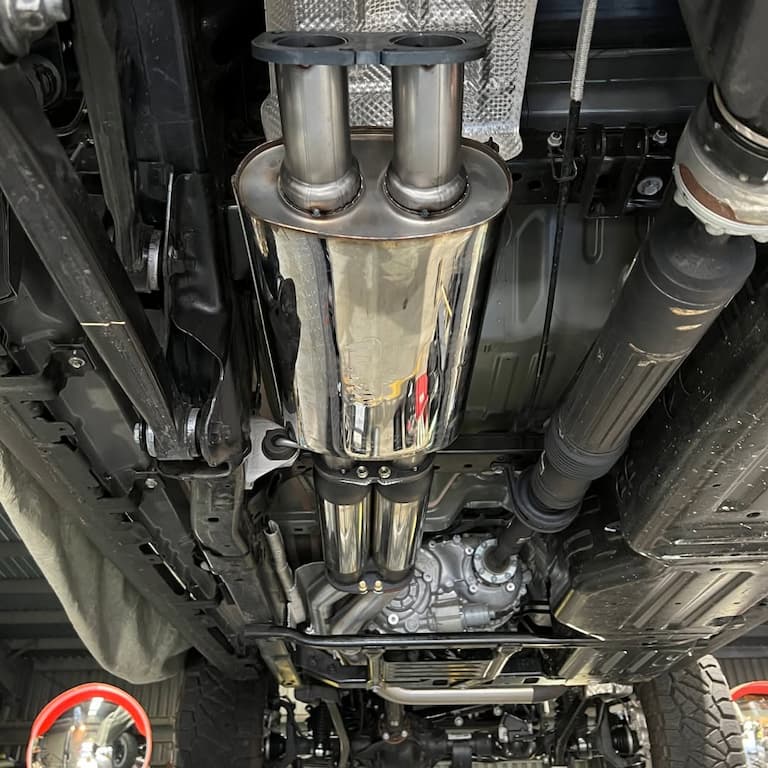
Mufflers do several things simultaneously. They cancel out pressure and sound waves to essentially “muffle” the explosions as the engine produces power, regulate airflow restrictions by reducing backpressure, and burn remnant toxic gases that catalytic converters miss. Most production cars feature chambered mufflers designed with internal metal plates and sound-absorbing materials to maximise cabin comfort and ensure a quiet ride. The trade-off, however, is increased backpressure that kills engine performance by limiting exhaust flow.
For new exhaust builds, consider turbo mufflers with S-shaped perforated internal tubing, where exhaust gases are pushed through multiple chambers. This balances flow to produce an exhaust sound with more character, while boosting performance with fewer restrictions. The layout is a common factory setup in top-trim performance cars, such as the VW Golf GTI, Subaru WRX, Audi S and RS cars and the Mitsubishi Lancer EVO, among other models.
If this doesn’t get you the power numbers or sound characteristics you want, go with straight-through or glass-pack mufflers. These have a perforated straight tube, surrounded by layers of sound-deadening materials (usually fibreglass or steel wool). The result is minimal flow restriction and a louder, more aggressive exhaust note. Bear in mind, these are track-only setups and geared towards high-production cars or extreme exhaust and engine builds.
Durability and Leak-Free Connections
Exhaust systems are more complex than most car enthusiasts and motorists would like to admit. To seal and connect piping parts like mufflers and catalytic converters, and prevent vibrations or durability issues in new builds, consider the outsized role of seals, gaskets, fasteners, and clamps.
Seal flanges and gaskets create an airtight connection between the engine and exhaust parts. These universal exhaust components pair headers to manifolds, mid-pipes to cats and mufflers to tailpipes. This ensures that the exhaust system maintains pressure throughout the entire length, that toxic and unburnt gases don’t leak, and sound levels remain sane. Choose multi-layer steel for durability and high-pressure and temperature ratings in moderate performance upgrades. Opt for more flexible and compressible graphite seals when mating headers to older or turbocharged engines. Or choose copper seals and exhaust flanges in high-performance builds due to their extreme strength and heat resistance. To ensure proper mating and reduce the likelihood of leaks and vibrations, pair seals with compatible exhaust gaskets.
Bolts, nuts and studs are another overlooked category. The primary role is to clamp adjoining parts, compress seals and gaskets, prevent leaks and withstand the high temperatures of fuel burns. This ensures the integrity of the system as a whole. Common examples include hex head bolts used on catalytic converters and tailpipes, studs connecting engine blocks, manifolds and header pipes and flange bolts with washers used with flanges for airtight connections.
When buying exhaust fasteners, consider how materials determine overall strength and durability. Go with high-grade steel alloys (304 or 409 stainless) for high tensile strength and rust resistance, heat-treated chromoly fasteners to withstand extreme pressures (such as turbo and supercharger engine builds) or costlier Inconel in pure racing applications.
To complete the list, consider compatible exhaust hangers to prevent excessive swaying and vibrations in connected parts and secure the entire system to the underbody while preventing alignment issues, possible leakage and exhaust drone and sounds from vibrating components.
Tailoring Air-Fuel Ratios with Oxygen Sensors
Upgrading exhausts with wide-diameter aftermarket piping and matching hardware can change pre-set air-fuel ratios. These are picked up by the vehicle’s ECU from data relayed from factory oxygen sensors. Computers can detect whether the engine is running lean (with too much air) or rich (with too much fuel) and will compensate performance metrics to balance fuel use while ensuring the least possible wear or damage to engine parts. While stock sensors work with minor exhaust upgrades, they are limited in readings for more precise results. Moreover, wider and straighter piping leads to leaner readouts, prioritising airflow.
The easy solution is wideband oxygen sensors, fitted before and after the catalytic converter. These help balance the fuelling, prevent extreme temperatures or hesitant throttle response and ensure your new exhaust perfectly matches the engine and electronics.
