
Contents
In metalworking environments, components must be shaped, finished, and replicated with consistency, especially in industrial or fabrication settings where tolerances matter. This is where metal lathe machines remain central to machining workflows, offering controlled rotation of workpieces so cutting tools can shape material with accuracy and repeatability. Their role spans everything from turning and facing to threading and boring, making them one of the most versatile machine tools in engineering.
Across workshops, demand varies widely. Some operations prioritise compact, high-precision machining, while others require heavy-duty capability for large or dense materials.
Because of this range, understanding how these machines differ in capacity, rigidity, and configuration becomes essential before any investment decision is made. The selection process is not only about power but also about how effectively a machine aligns with expected workloads and production consistency. This is why choosing reliable metal lathe machines can directly affect output consistency today while shaping how efficiently a workshop can scale future workloads and part complexity.
The Turning Point in Workshop Performance
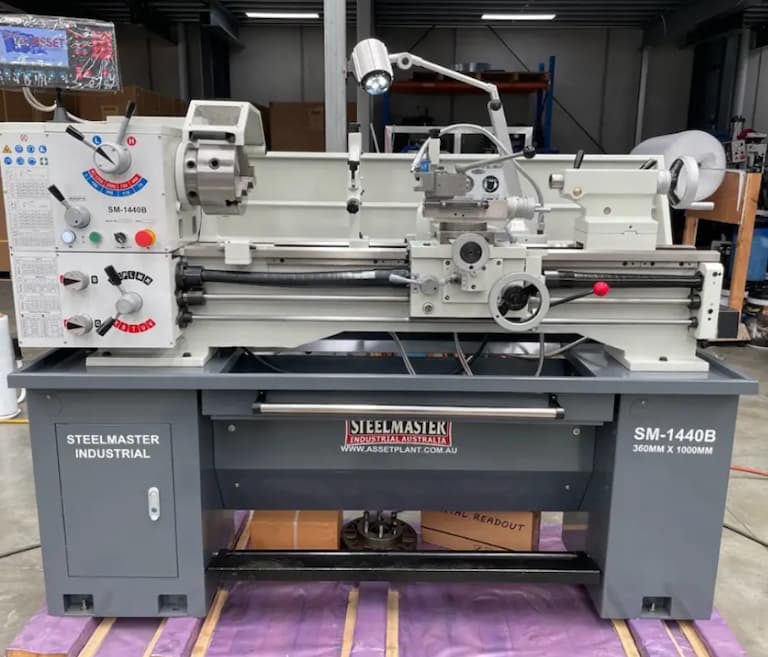
Industrial lathes are generally grouped by their intended workload and structural capacity. Workshop and toolroom types are commonly used for smaller components requiring high precision, often found in maintenance environments or light fabrication.
Centre lathes expand capability with greater swing and bed length, making them suitable for general-purpose machining tasks. At the larger end, heavy-duty and large-bore variants are designed for substantial workpieces, where material size and cutting force requirements are significantly higher.
Key specs such as swing over bed, distance between centres, and spindle bore diameter directly influence what can be processed. A larger swing allows greater diameter work, while bed length determines how long a component can be machined without repositioning. Spindle bore size is especially important when working with bar stock, as it dictates how much material can pass through the machine during operation.
Understanding these capacity differences ensures the machine you select aligns with real production demands rather than theoretical capability. In practice, this prevents inefficiencies such as underutilised equipment or machines that cannot handle peak workload requirements.
Additionally, metal lathes generally fall into a few core types depending on how they’re used in practice. Manual lathes are operated directly by a machinist and are common in smaller workshops where hands-on control is important. CNC lathes use programmed commands to automate cutting, allowing for higher precision and repeatability in larger production runs.
Toolroom lathes are designed for fine, accurate work such as prototyping and precision components, while heavier industrial lathes are built to handle larger workpieces and continuous machining demands. Each type differs mainly in control method, scale, and level of precision.
Capacity, Growth and Accuracy
Performance in machining is not determined by size alone. Structural rigidity plays a major role in how consistently a machine maintains tolerance during operation. Heavier cast bases, reinforced beds, and precision-ground components help reduce vibration, which directly impacts surface finish and tool life.
Modern configurations of metal lathe machines often prioritise improved alignment systems and smoother carriage movement, allowing operators to achieve finer control during cutting operations. This is particularly important in repetitive production environments, where even small deviations can compound into significant inconsistencies over time.
Another important factor is spindle performance. Stable rotational speed and balanced load distribution help maintain accuracy during both light finishing cuts and heavier roughing operations. Combined with reliable feed systems, this creates a machining environment where precision is maintained across extended production cycles.
Workshop Fit and Operational Reality
Beyond machine capability, practical workshop conditions heavily influence performance outcomes. Available floor space, access for loading materials, and electrical requirements all shape how effectively a lathe can be integrated into daily operations. Even highly capable machines can become inefficient if the surrounding setup restricts workflow movement or material handling.
Operator familiarity is another often overlooked factor. Machines with more advanced control systems may offer greater precision, but they also require a higher level of technical understanding. Conversely, simpler mechanical systems may be easier to operate but offer fewer automation benefits.
Maintenance requirements also play a role in long-term usability. Regular lubrication, alignment checks, and component inspection ensure consistent performance and reduce wear over time. Machines designed with accessible service points typically allow faster upkeep, which is critical in environments where downtime directly affects output.
Workshop Considerations
- Evaluate the suitability of machine capacity for typical and peak workpiece dimensions.
- Assess spindle performance requirements based on material type and machining intensity.
- Review alignment stability and vibration control for precision-focused operations.
- Consider integration with existing workshop layout and material handling flow.
- Prioritise long-term operational reliability over short-term equipment cost savings.
Where Workshop Decisions Settle Into Steel
Selecting machining equipment ultimately comes down to alignment between capability and application. When metal lathe machinery is chosen with careful attention to structural capacity, operational stability, and workshop conditions, it becomes a consistent production asset.
Across industrial environments, their value is measured not only by what they can cut, but by how reliably they can repeat precision under continuous use. Whether handling fine detailing or heavy material removal, the right configuration supports smoother workflows and reduces operational uncertainty.
In practice, a well-matched metal lathe machine reduces strain on both operators and production schedules, ensuring that output remains steady even as demand shifts. The result is a more controlled, predictable machining process that supports long-term workshop efficiency and capability growth.
